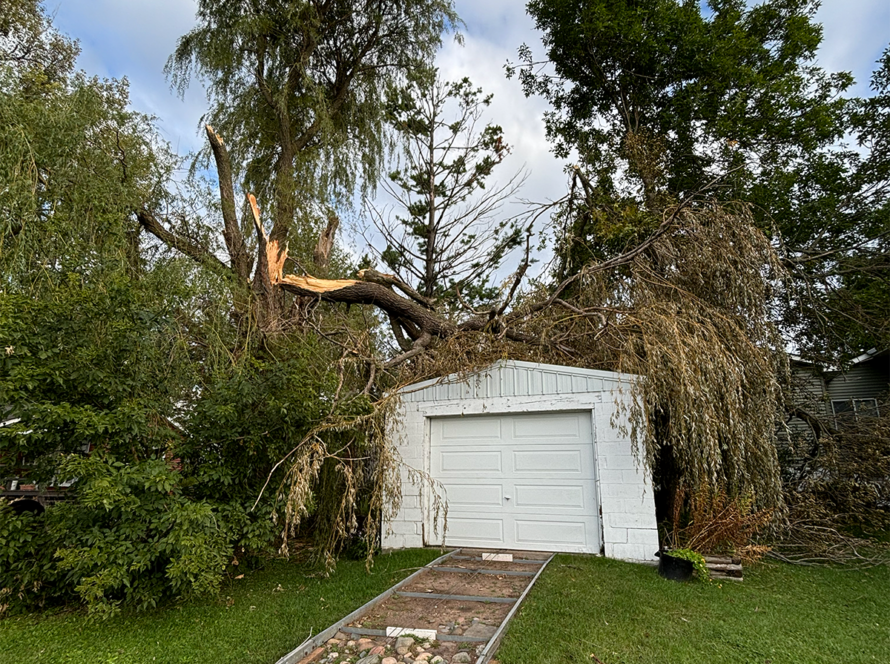
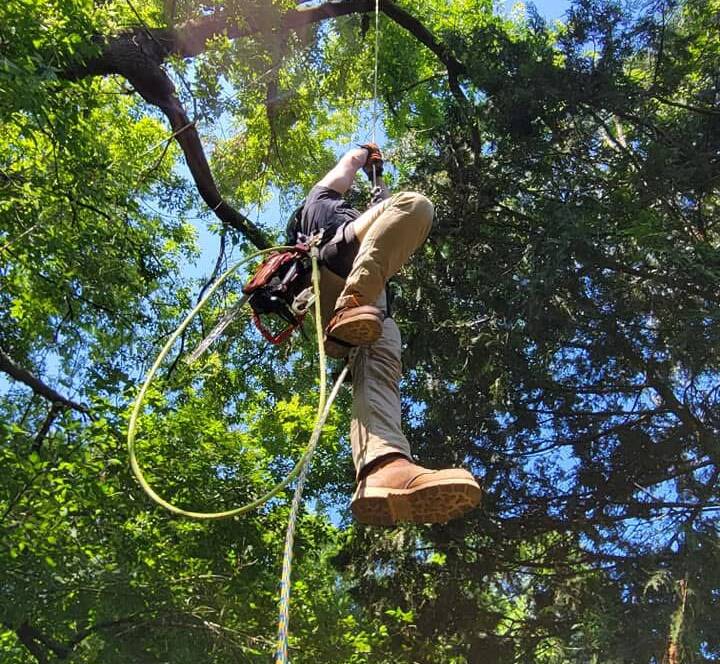
Not every tree can be saved — and waiting too long to remove a hazardous tree puts your home, family, and property at risk. Here are the five most common signs that it’s time to call a professional tree service for removal.
1. The Tree Is Dead or Dying
A dead tree has no structural integrity. Branches become brittle and snap without warning. The bark peels away in large sections, and the wood beneath is dry and crumbling. If your tree has no leaves during the growing season (or sparse, discolored leaves on only a few branches), it may be dead or in severe decline. Dead trees don’t hold themselves together in wind — they fall. In Northwestern Wisconsin, dead ash trees from emerald ash borer infestations are especially common and dangerous. A dead tree near your home, vehicle, or power lines should be removed promptly.
2. The Tree Has Major Structural Damage
Structural cracks running up the trunk, large hollowed-out cavities, or a pronounced lean are all serious warning signs. A split crotch — where a major limb attaches at an angle rather than a healthy collar — is a failure point waiting to happen. Trees that have been topped (had their main leader removed) often develop weak, multiple competing leaders that are prone to splitting under ice or wind load. If you notice large cracks in the trunk, mushrooms or conks growing at the base (a sign of internal rot), or visible decay inside a hollow section, have a professional assess it immediately.
3. The Tree Is Too Close to Your Home or Power Lines
A tree doesn’t have to be dead to be dangerous. Healthy trees growing within striking distance of your roof, foundation, or overhead utilities are a liability. Large overhanging limbs over the roofline can cause catastrophic damage in a storm. Roots encroaching on your foundation or septic system cause costly structural damage over time. Trees leaning toward structures — even slightly — need professional evaluation. In many cases, targeted trimming can solve the problem. In others, removal is the safer, more cost-effective long-term solution.
4. The Trunk Is Hollow or Shows Signs of Decay
A tree can look healthy from the outside while being structurally compromised on the inside. External signs of internal decay include: fungal conks (shelf-like mushrooms growing from the bark), sawdust-like material at the base, soft or spongy wood when probed, ants and carpenter bees in the trunk, and woodpecker activity (they find insects in dying wood). A hollow trunk doesn’t automatically mean removal — it depends on the percentage of sound wood remaining. But any significant internal decay near the base should be professionally evaluated before the next storm season.
5. Multiple Failed Limbs or Heavy Branch Dieback
If your tree has lost multiple large limbs over the past few seasons — especially from the interior or upper crown — it’s declining. Healthy trees don’t regularly self-prune large structural limbs. Widespread branch dieback, especially when paired with leaf scorch, discoloration, or pest activity, often indicates a systemic problem: root damage, soil compaction, severe disease, or insect infestation. At some point, the cost of ongoing trimming and monitoring exceeds the value of the tree, and removal is the practical answer.
When in Doubt, Get a Professional Assessment
These signs don’t always mean automatic removal — but they all warrant a professional opinion before the situation worsens. At Roufs Tree Service, we provide free on-site evaluations with honest recommendations. We’ll tell you if a tree can be saved with trimming or treatment, and we’ll give you a clear picture of the risk if it can’t. There’s no pressure and no obligation. Call us at (715) 566-4401 or request a free estimate online.
Ut perspiciatis, unde omnis iste natus error sit voluptatem accusantium doloremque laudantium, totam rem aperiam eaque ipsa, quae ab illo inventore veritatis et quasi architecto beatae vitae dicta sunt, explicabo.
Sed ut perspiciatis, unde omnis iste natus error sit voluptatem accusantium doloremque laudantium, totam rem aperiam eaque ipsa, quae ab illo inventore veritatis et quasi architecto beatae vitae dicta sunt, explicabo.